
- Digitale Edition
- /IG I³, 1
- /I. Decreta et leges
- /1. Decreta et leges secundum aetatem ordinata
- /IG I³ 4(B)
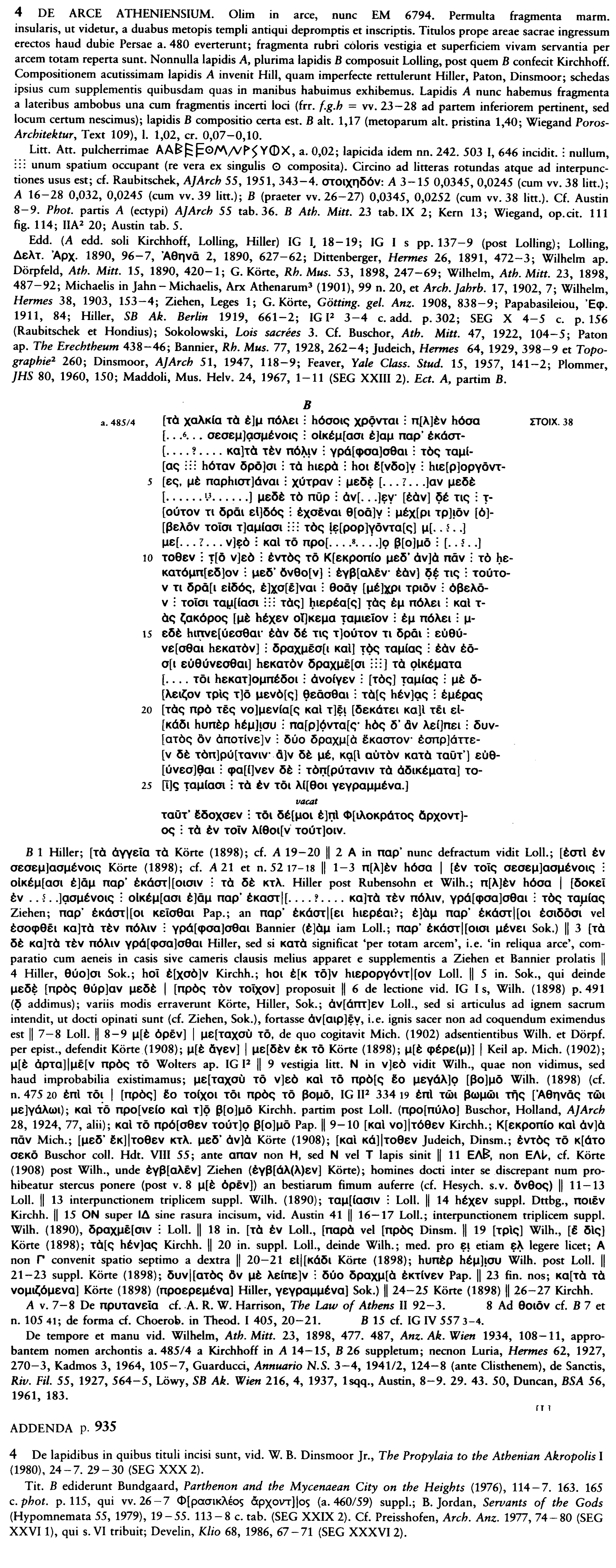
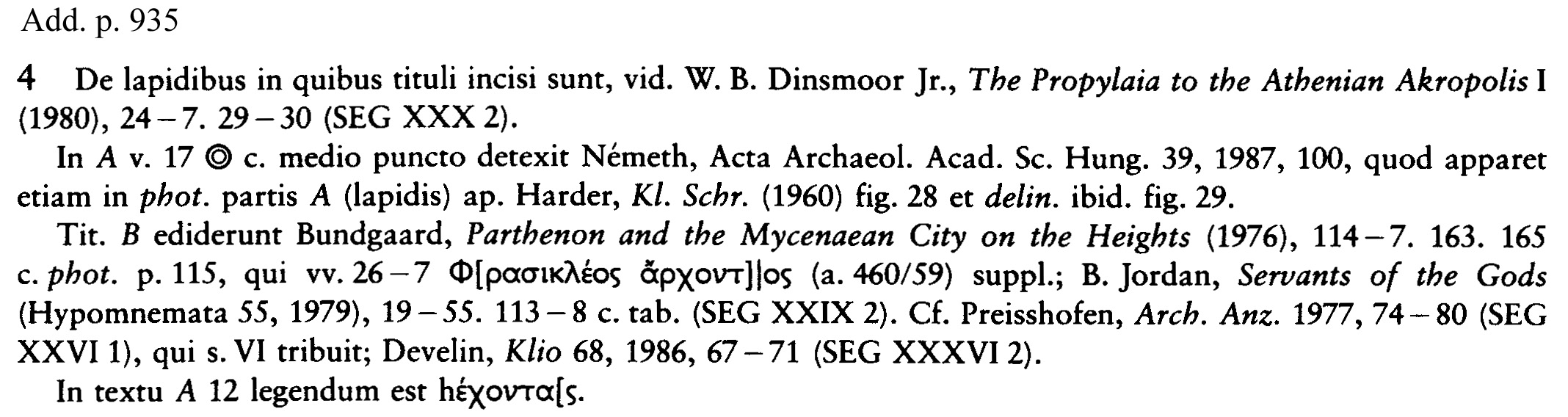
1[τὰ χαλκία τὰ ἐ]μ πόλει ⁝ hόσοις χρ̣νται ⁝ π[λ]ὲν hόσα
1Die Bronzegeräte auf der Akropolis, soviele in Gebrauch sind, außer denen,
2[. . .6. . . σεσεμ]α̣σμένοις ⁝ οἰκμ[ασι ἐ]αμ παρ ἑκάστ‒
2die - - - in den versiegelten Gebäuden, wenn bei jedem
3[. . . . .9. . . . κα]τὰ τὲν πόλ̣ι̣ν ⁝ γρά[φσα]σθαι ⁝ τὸς ταμί‒
3- - - auf der Akropolis, dass (sie) die Schatzmeister verzeichnen;
4[ας ⁝⁝⁝ hόταν δρ]σι ⁝ τὰ hιερὰ ⁝ hοι ἔ[νδο]ν̣ ⁝ hιε[ρ]οργντ‒
4wenn (Leute) die Opfer vollziehen, die im Inneren opfern,
5[ες, μὲ παρhιστ]άναι ⁝ χύτραν ⁝ μεδὲ̣ [. . . .7. . .]αν μεδὲ
5dass sie das Keramikgefäß nicht stellen weder - - - noch
6[. . . . . . .13. . . . . .] μεδὲ τὸ πῦρ ⁝ ἀν[. . .]ε̣ν̣· [ἐὰν] δ̣έ τις ⁝ τ̣‒
6- - - noch das Feuer - - -; wenn aber einer
7[ούτον τι δρᾶι εἰ]δός ⁝ ἐχσναι θ[οᾶ]ν̣ ⁝ μέχ[ρι τρ]ι̣ν [ὀ]‒
7davon etwas wissentlich tut, dass ihn bis zu drei Obolen zu bestrafen gestattet
8[βελν τοῖσι τ]αμίασι ⁝⁝⁝ τὸς ἱ̣ε̣[ρορ]γ̣ντα[ς] μ[. . .5. .]
8sei den Schatzmeistern; dass die Opfernden - - -
9με[. . . .7. . . ν]ε̣ὸ ⁝ καὶ τ προ[. . . .8. . . .]ο̣ β̣[ο]μ ⁝ [. . .5. .]
9- - - des Tempels und - - - des Altars - - -
10τοθεν ⁝ τ̣[ ν]εὸ ⁝ ἐντὸς τ Κ[εκροπίο μεδ ἀν]ὰ πᾶν ⁝ τὸ hε‒
10- - - des Tempels innerhalb des Kekropion und insgesamt im
11κατόμπ[εδ]ον ⁝ μεδ ὄνθο[ν] ⁝ ἐγβ[αλν· ἐὰν] δ̣έ̣ τις ⁝ τούτο‒
11Hekatompedon, noch den Unrat hinauswerfen; wenn aber jemand davon
12ν τι δρᾶ[ι εἰδὸς ἐ]χ̣σ[]ναι ⁝ θοᾶν̣ [μέ]χ̣ρι τριν ⁝ ὀβελ‒
12etwas wissentlich tut, dass ihn bis zu drei Obolen zu bestrafen gestattet
13ν ⁝ τοῖσι ταμ̣[ίασι ⁝⁝⁝ τὰς] hιερέα[ς] τ̣ὰς ἐμ πόλει ⁝ καὶ τ‒
13sei den Schatzmeistern; dass die Priesterinnen auf der Akropolis und
14ὰς ζακόρος [μὲ hέχεν οἴ]κεμα τ̣αμιεῖον ⁝ ἐμ πόλει ⁝ μ‒
14die zakoroi kein Vorratsgebäude haben auf der Akropolis und
15εδὲ hιπνε[ύεσθαι· ἐὰν δέ τις τ]ούτον τι δρᾶι ⁝ εὐθύ‒
15auch nicht mit offenem Feuer kochen; wenn aber eine etwas davon tut, dass sie
16νε[σθαι hεκατὸν] ⁝ δραχμσ[ι καὶ] τ̣ὸ̣ς ταμίας ⁝ ἐὰν ἐ‒
16gestraft werde um einhundert Drachmen, und die Schatzmeister, wenn sie es zulas-
17σ[ι εὐθύνεσθαι] hεκατὸν δραχμ[σι ⁝⁝⁝] τὰ ο̣ἰκέματα
17sen, gestraft werden (ebenfalls) um einhundert Drachmen; dass die Gebäude
18[. . . . τι hεκατ]ομπέδοι ⁝ ἀνοίγεν ⁝ [τὸς] τ̣αμίας ⁝ μὲ ὄ‒
18- - - im Hekatompedon die Schatzmeister aufschließen sollen nicht
19[λειζον τρὶς τ] μενὸ[ς] θ̣εᾶσθαι ⁝ τὰ[ς hέν]α̣ς ⁝ ἑμέρ̣ας
19weniger als dreimal im Monat zur Besichtigung, an den (jeweils) ersten Tagen
20[τὰς πρὸ τς νο]μενία[ς καὶ τ]ε̣̑ι̣ [δεκάτει κα]ὶ τι εἰ‒
20vor dem Neumond und am zehnten Tag und am zwan-
21[κάδι hυπὲρ hέμ]ι̣συ ⁝ πα[ρ]ό̣ντα[ς· hὸς δ ἂν λεί]πει ⁝ δυν‒
21zigsten, wobei mehr als die Hälfte anwesend sein sollen; wer aber fehlt, obwohl
22[ατὸς ὂν ἀποτίνε]ν ⁝ δύο δραχμ[ὰ ἕκαστον· ἐσπρ]άττε‒
22es ihm möglich gewesen wäre, dass jeder zwei Drachmen Strafe zahle; dass der
23[ν δὲ τὸπ]ρύ[τανιν· ἂ]ν δὲ μέ, κα̣[ὶ αὐτὸν κατὰ ταῦτ᾿] εὐθ‒
23Vorsitzende eintreibt; falls nicht, dass er selbst gemäß diesen (Vorschriften)
24[ύνεσ]θ̣αι ⁝ φα[ί]νεν δὲ ⁝ τὸπ̣[ρύτανιν τὰ ἀδικέματα] το‒
24Strafe zahle; dass anzeige der Vorsitzende den Schatzmeistern
25[ῖ]ς̣ τ̣αμίασι ⁝ τὰ ἐν τι λί[θοι γεγραμμένα].
25die Vergehen, die auf dem Stein aufgezeichnet sind.
vacat
vacat
26ταῦτ ἔδοχσεν ⁝ τι δέ[μοι ἐ]π̣ὶ Φ[ιλοκράτος ἄρχοντ]‒
26Dies beschloss das Volk unter dem Archon Philokrates,
27ος ⁝ τὰ ἐν τοῖν λίθοι[ν τούτ]οιν.
27was auf diesen beiden Steinen (steht).
Konkordanz
SEG
- SEG LXVIII 16
- SEG LXX 28
- SEG X 4
- SEG X 5
- SEG XXI 2
- SEG XXIII 2
- SEG XXV 2
- SEG XXVI 1
- SEG XXIX 2
- SEG XXX 32
- SEG XXXVI 2
- SEG XXXVII 249
- SEG XXXVII 1782
- SEG XLIII 1
- SEG XLIII 1235
- SEG XLIV 1
- SEG XLIV 1735
- SEG XLVI 36
- SEG XLVII 53
- SEG XLVIII 43
- SEG L 30
- SEG L 31
- SEG L 75
- SEG LI 26
- SEG LIII 13
- SEG LVI 49
- SEG LVII 1
- SEG LVII 54
- SEG LVIII 15
- SEG LVIII 46
- SEG LIX 41
- SEG LX 62
- SEG LXI 15
- SEG LXI 57
- SEG LXII 1833
- SEG LXIII 35
- SEG LXIII 1761
- SEG LXIV 28
- SEG LXIV 224
- SEG LXV 21
- SEG LXVI 8
- SEG LXVI 13
- SEG LXVI 22
IG
- IG I² 4
Bilder
Abklatsche

CC-BY 4.0

CC-BY 4.0

CC-BY 4.0

CC-BY 4.0

CC-BY 4.0

CC-BY 4.0

CC-BY 4.0

CC-BY 4.0

CC-BY 4.0

CC-BY 4.0

CC-BY 4.0

CC-BY 4.0

CC-BY 4.0
Editio
CC-BY 4.0
CC-BY 4.0